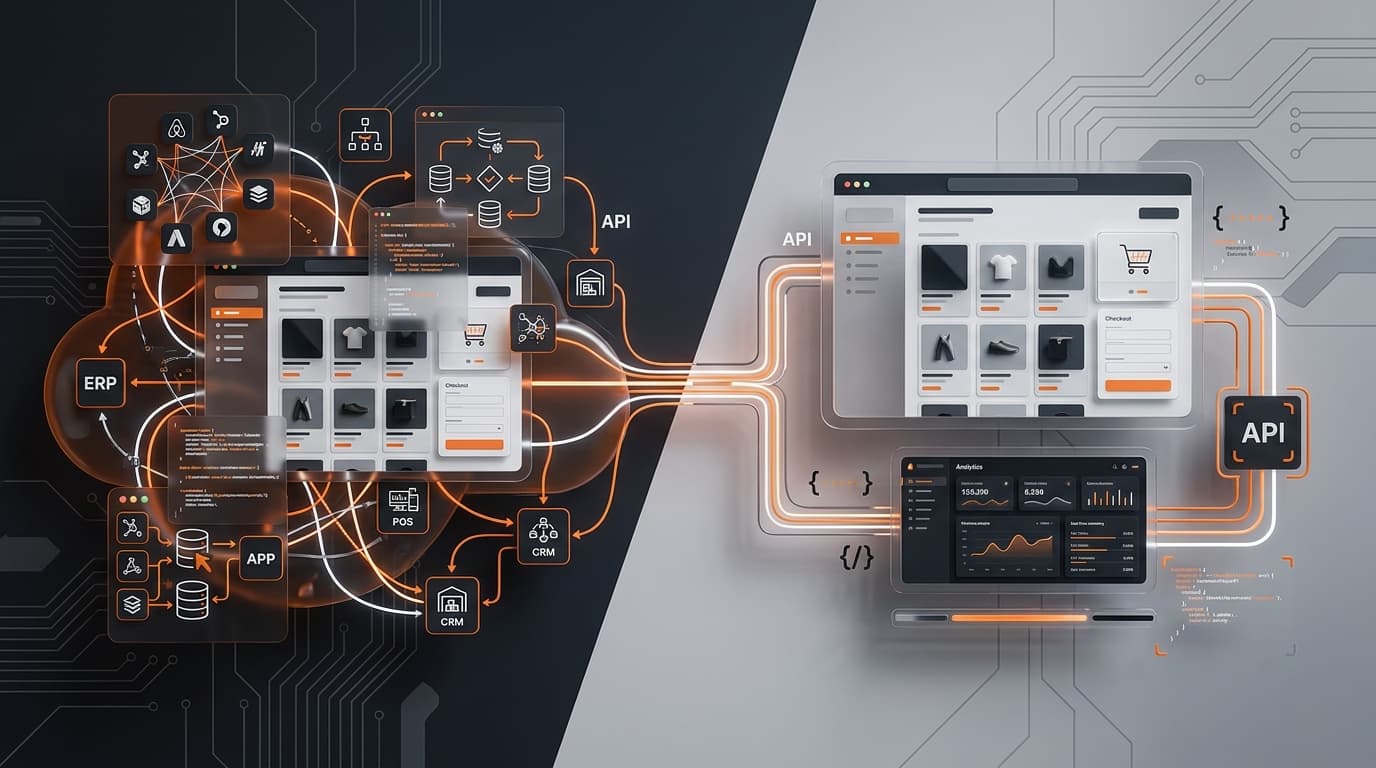
There's a critical moment in every growing Shopify store's life — a point where the platform that made starting easy starts making growing hard. Apps conflict. Themes resist. Integrations break. The checkout won't bend. You keep hearing the same phrase from every developer you approach: "Sorry, Shopify doesn't support that natively."
That moment is not a sign to abandon Shopify. It's a sign to stop treating it as a DIY platform and start treating it as the powerful commerce engine it is — one that, with the right custom Shopify development partner, can grow as fast as your ambition.
Here are the 7 unmistakable signs you've reached that point.
Sign One — Design & Brand Your Theme Is a Creative Cage Your Brand Keeps Hitting
Every Shopify theme — Dawn, Impulse, Prestige, and all the rest — is engineered to serve thousands of stores across dozens of industries. That breadth is their commercial advantage. It is also their fundamental limitation. A theme designed for everyone is optimised for no one.
When your brand has a genuine identity — a point of view on how a product should feel before it's purchased, a content hierarchy that's specific to your customer, a visual language that doesn't fit inside a dropdown of pre-set sections — a theme stops being a starting point and starts being a constraint. You spend hours working around it. Your designer produces mockups the theme can't execute. Your store looks like a Shopify store, not a brand.
You've Hit This Wall If…
- Your design team delivers brand-accurate mockups that can't be implemented in your current theme
- Every unique section you want requires expensive theme code edits that break with updates
- Your homepage, product pages, and collections all share the same rigid layout regardless of content
- You can't build the interactive product experience your customers expect — configurators, 3D views, comparisons
- Anyone familiar with Shopify could immediately identify the theme underneath your store
Consumers judge brand credibility from the first visual impression — and a generic theme signals a generic brand. Custom theme development removes that ceiling entirely: every layout, animation, and interaction decision is made deliberately for your store and your customers.
Sign Two — Apps & Performance App Sprawl Is Silently Bleeding Your Store's Performance
The Shopify App Store offers 8,000+ solutions. That's genuinely impressive — but it creates a trap that catches a majority of growing merchants. A review app here. A loyalty app there. A upsell app, a bundle app, a personalisation app, a shipping rules app. Each solves a problem. Each adds its own JavaScript and CSS to every page your customers visit. None of them were designed to work together.
The result is "app sprawl" — a store running 12, 18, or 25 third-party apps whose combined weight slows page load to a crawl, creates JavaScript conflicts that cause unpredictable bugs, and accumulates monthly fees that add up to more than custom development would have cost.
Interactive Tool
How Much Are Your Shopify Apps Really Costing You?
The conflict problem: Beyond cost, app conflicts are a silent conversion killer. When two apps modify the same page element — cart, product page, checkout — the result can be broken UI, failed cart additions, or silent checkout errors that you won't notice until customers complain. Custom development eliminates this entirely: one codebase, one team, zero conflicts.
Sign Three — Checkout & Conversion Your Checkout Is Leaking Revenue on Every Single Order
The average Shopify cart abandonment rate is 70.19%. That number alone should make the checkout the single most-scrutinised page in any Shopify merchant's business. Yet for most stores on standard plans, it's also the page they have the least control over.
Shopify's native checkout is fast, secure, and well-optimised for the average use case. But "average" is not your store. Your customers abandon for specific, identifiable reasons — and many of those reasons require custom development to fix. As of August 2024, checkout.liquid is officially deprecated, and true checkout customisation now requires Shopify Plus and Checkout Extensibility — which itself demands a developer who knows how to push it.
Why Customers Are Abandoning Your Checkout
| Abandonment Reason | % of Abandonments | Custom Dev Fix |
|---|---|---|
| Unexpected shipping costs revealed at checkout | 48–49% | Dynamic shipping calculator on product page |
| Checkout process too complex or too many steps | 31% | One-page checkout or streamlined Extensibility build |
| Forced account creation before purchase | 24% | Seamless guest checkout with optional account creation |
| Slow page load at the checkout stage | 22% | Performance optimisation and lightweight checkout build |
| Preferred payment method not available | 15% | Custom payment gateway integration |
"Custom checkout improvements deliver an average 35% conversion uplift. For a store processing $500K/year, that's $175,000 in additional revenue from a single project — before you touch a single other page." — Alliance IT Solutions, eCommerce Development Team
🚀 Free Offer — Limited Availability
Is Your Shopify Store Leaving Money on the Table?
Our Shopify specialists review your store's performance, conversion data, and technical setup — then tell you exactly what custom development would unlock. No cost. No commitment.
✓ No sales pitch · ✓ Actionable recommendations you keep · ✓ Reply within 24 hours
Sign Four — Platform Limits Shopify's Native Feature Set Has Become Your Business's Ceiling
Shopify is built for the widest possible audience. That means its native features are excellent for the majority of merchants — and insufficient for those with specific, non-standard requirements. If your business has unusual needs that don't map neatly onto what Shopify ships out of the box, you'll hit hard walls that no setting, no app, and no Shopify support ticket can resolve.
Common Native Limits That Stop Growth
- Product variants: Shopify caps you at 3 option types and 100 variants per product. Stores selling customisable, configurable, or complex products hit this wall fast — and the workarounds degrade the customer experience
- B2B and wholesale: Customer-specific pricing, net payment terms, volume discounts, and company-level accounts aren't possible on standard Shopify without Plus or custom development
- Subscription commerce: True flexible subscriptions — custom billing cycles, pause/resume, failed payment recovery — require custom app development that goes far beyond standard subscription apps
- Complex discounting: Shopify's native discount engine can't handle stacking rules, tiered loyalty discounts, or conditional promotional logic without custom Shopify Functions development
- International complexity: Multiple storefronts with currency, language, and inventory rules tailored per market demand architecture that exceeds standard Shopify Markets
Important distinction: Shopify Plus unlocks more — but it doesn't solve everything. Many Plus merchants still need custom development for the functionality their business actually requires. The platform tier and the development work are separate decisions. Custom development works on all Shopify plans.
Sign Five — Integrations Your Team Spends Hours Manually Moving Data Between Systems
Shopify is rarely the only system your business runs on. You have an accounting platform. A CRM. A warehouse management system. A third-party logistics partner. An ERP. A custom loyalty database. When these systems don't communicate with Shopify automatically and reliably, the gap is filled by the most expensive and error-prone resource available: manual human effort.
Spreadsheet exports. Copy-paste order transfers. Inventory reconciliation by hand. Stock discrepancies that result in overselling. A team member whose entire job is bridging your systems. All of these are symptoms of the same underlying problem: missing custom integrations between Shopify and the tools your business depends on.
Integration Scenarios That Need a Custom Development Partner
- Syncing Shopify orders and inventory with an ERP or WMS that has no pre-built Shopify connector
- Real-time two-way stock sync between multiple warehouse locations and your live Shopify storefront
- Connecting your Shopify store to a custom CRM, loyalty platform, or internal data warehouse
- Automated order routing between Shopify and multiple 3PL or fulfilment partners based on product rules
- Marketplace sync with Amazon, Trade Me (NZ), or eBay — pulling orders back into Shopify automatically
If your team spends 10 hours per week on manual data tasks at $35/hour average cost, that's $18,200/year in pure overhead — and it grows with every order. A single well-built custom integration typically delivers full payback within 4–6 months, then saves that cost every year indefinitely.
Sign Six — Performance & Scalability Your Store Slows to a Crawl When You Need It Most
Product launches. Black Friday. Viral moments. Flash sales. These are the events that define a year in eCommerce — and they're also the moments when an underperforming store reveals itself with the worst possible timing. A store that loads quickly with 50 concurrent users and struggles with 500 has a scalability problem that will get worse, not better, without architectural intervention.
Most Shopify performance issues trace back to the same causes: excess app scripts loading on every page, theme code that wasn't optimised for production, image delivery that isn't edge-cached, and no strategy for handling peak traffic gracefully. These are solvable problems — but they require a developer who can work at the code level, not just install a different theme.
Performance Metrics That Signal a Problem
- Google PageSpeed mobile score below 65 — directly suppressing SEO rankings and ad Quality Scores
- Largest Contentful Paint (LCP) above 4 seconds — costing conversions on your most traffic-heavy pages
- Core Web Vitals failing in Google Search Console — a confirmed Google ranking factor since 2021
- Noticeable slowdown during promotional events, email campaigns, or influencer mentions
- Mobile conversion rate significantly below desktop (Shopify avg: 1.8% mobile vs 3.9% desktop — a gap that widens with poor performance)
SEO cost of poor performance: Google's Core Web Vitals are a ranking signal. A store with consistently poor LCP and CLS scores is penalised in search results every day — meaning slower load times don't just hurt the shopper experience, they actively reduce the organic traffic you're paying to earn through SEO and content.
Sign Seven — Competitive Position You Feel Embarrassed Sending Prospects to Your Own Website
This is the most honest sign of all — and the one most business owners are reluctant to admit. When a prospective customer asks for your website, do you find yourself adding a caveat? "It's a bit outdated, we're working on it." "The design isn't great but the products are amazing." "Ignore the homepage, just go straight to the products."
That hesitation is data. It tells you that your website is not doing its most important job: making a strong, trustworthy first impression before you get the chance to make your pitch in person. Every prospect who visits your store before you've had the chance to brief them is forming a judgement based purely on what they see. If what they see doesn't match the quality of your actual products or service, you're fighting an uphill battle before the conversation starts.
The Competitive Reality in 2025
Right now, your competitors are not standing still. The brands that are winning in your market are investing in custom-built Shopify stores that load faster, look more polished, and guide customers more clearly toward a purchase. They're outranking you in search. They're converting more of the same traffic you're both paying to acquire. And every month you wait is a month that gap widens.
The simplest test: Open your store and three competitor stores in separate tabs. Be ruthless about your first impression of each. Which one would you trust with your payment details? Which one signals "serious business"? Your customers are doing this comparison too — often in the same browser session.
A custom Shopify store can't be cloned by a competitor installing the same theme. The unique UX, the specific conversion flows, the performance optimisations — these are built for your business and your customers. Over time, they compound into an advantage that's increasingly difficult to replicate.
Why Choose Alliance IT Solutions
Shopify Custom Development Across the US, Australia & New Zealand
Shopify stores built, customised, and scaled for merchants across three markets
Turnaround on consultation responses — you'll know our recommendations fast
Average conversion improvement across our custom Shopify development projects
What We Build for Shopify Merchants
Custom Development Services Across the Full Shopify Stack
Free Self-Assessment
Is Your Shopify Store Ready for Custom Development?
Tick every statement that applies to your store right now. Your readiness score and recommendation appear below.
- My store looks and feels like a Shopify template, not a distinctive brand
- I'm running more than 8 paid third-party apps
- My monthly Shopify app spend exceeds $300/month
- My cart abandonment rate is consistently above 65%
- I need product options that exceed Shopify's native 3-type limit
- My team manually transfers data between Shopify and other systems each week
- My store noticeably slows during sales events, launches, or email campaigns
- My Google PageSpeed mobile score is below 70
- Competitor stores in my niche look and feel more professional than mine
- I feel uncomfortable or hesitant sending prospects directly to my website
- I need integrations with business systems that have no pre-built Shopify connector
- I know exactly what feature would improve conversions — but the platform won't let me build it
- We need B2B features — customer pricing, net terms, company accounts — that Shopify doesn't natively support
- My conversion rate has plateaued despite growing traffic and marketing spend
Your Score
Tick the boxes above to see your personalised readiness score and recommendation.
✦ Free Offer for US · AU · NZ Merchants
Get a Free Custom Shopify development Audit
Our Shopify development team reviews your store, identifies the 3 highest-impact custom development opportunities, and gives you a clear recommendation — all free, all in writing, within 24 hours.
- Performance & speed review
- Checkout conversion analysis
- App stack audit
- Integration gap assessment
- Competitor design comparison
- Custom dev opportunity map
- Written recommendations
- No obligation whatsoever
🔒 No spam. No sales scripts. Just honest, expert advice you can act on — whether you work with us or not.
Custom Development Isn't an Expense — It's the Investment That Removes Your Ceiling
Standard Shopify themes and apps are how you start. Custom Shopify development is how you scale. Every sign in this article represents a real, measurable constraint on your store's revenue potential — and every one of them is solvable with the right development partner.
The merchants growing fastest in the US, Australian, and New Zealand markets aren't the ones with the biggest ad budgets. They're the ones whose stores convert at 4% instead of 1.4%, whose checkouts don't leak 70% of carts, whose performance scores rank them above competitors in Google, and whose integrations mean their team spends time on customers — not copy-pasting data between systems.
If you recognised your store in three or more of these signs, the cost of staying where you are is already higher than the cost of moving forward. Book a free consultation with our Shopify development team — we'll tell you honestly what's costing you the most and what we'd build first to fix it.