How AI-Powered Search Is Reshaping Shopify SEO in the US, Australia, and NZ
Google AI Overviews, ChatGPT, Perplexity, and Bing Copilot are changing how customers find products online. Here's what it means for your Shopify store — and exactly what to do about it.
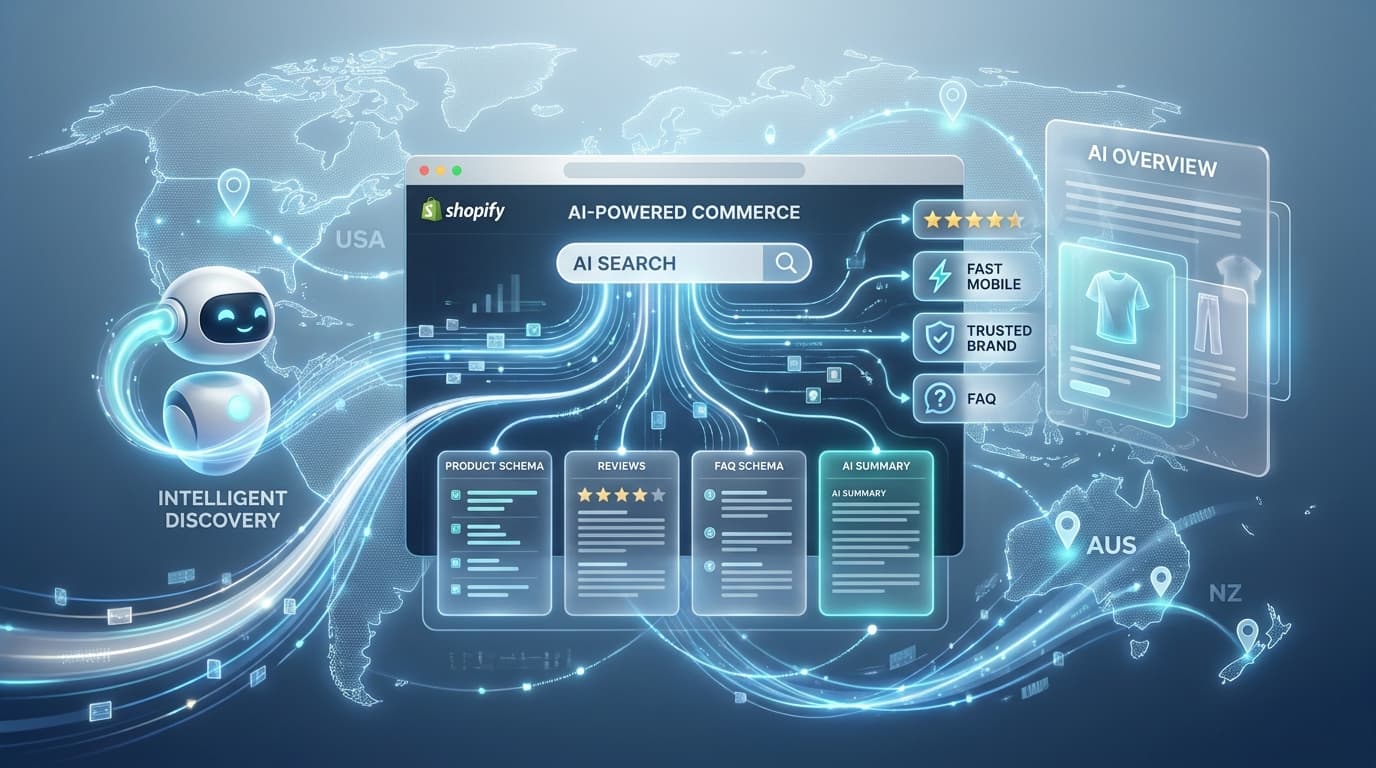
The Biggest Shift in Ecommerce Search Since Mobile
In 2023, most Shopify merchants were still playing the same SEO game they'd been playing for a decade — target keywords, build backlinks, optimize title tags, get to page one. It worked. Not perfectly, but reliably enough.
By 2026, that game has fundamentally changed. Google AI Overviews now appear at the top of results for a significant portion of commercial queries. ChatGPT and Perplexity are being used by millions of consumers to research products before buying. Bing Copilot synthesizes product comparisons without users ever visiting a store page. The traditional ten blue links — the backbone of ecommerce SEO for twenty years — are being partially displaced by AI-generated summaries that cite sources rather than send traffic to them.
This isn't cause for panic. It is cause for a strategy update. Shopify stores that understand what's changed — and specifically how AI search behaves differently across the US, Australian, and New Zealand markets — are going to capture traffic and revenue that less-prepared competitors lose.
This guide is for Shopify merchants who want to understand the mechanics, not just the buzzwords. We'll break down how AI search works, what it means for your specific market, and give you a clear, prioritized list of actions to take in 2026.
What AI-Powered Search Actually Is (And What It Isn't)
Before we can talk about optimizing for AI search, we need to be precise about what we mean. "AI search" isn't one thing. It's a collection of related technologies that each interact with your Shopify store differently.
Google AI Overviews (Previously SGE)
Google's AI Overviews generate a synthesized answer at the top of the search results page, pulling information from multiple web sources. For product-related queries, these summaries may include product comparisons, buying guides, and feature breakdowns — all assembled by Google's AI without the user clicking through to any individual store.
For top-of-funnel informational queries ("best running shoes for flat feet"), AI Overviews can reduce traffic to your blog and buying guide content. For bottom-of-funnel product queries ("buy Hoka Clifton 9 size 10 AU"), the click-through rate impact is less severe — users with purchase intent still need to actually buy. The important shift is that being cited in an AI Overview becomes a new form of visibility, even when users don't click.
Conversational AI Tools (ChatGPT, Perplexity, Claude)
An increasing number of consumers now begin product research by asking an AI chatbot rather than Googling. These tools synthesize information from their training data and, in many cases, live web searches. They don't return a list of stores — they return a narrative recommendation that may or may not mention your brand.
The implication for Shopify merchants: brand mentions, reviews, and detailed product information across the web (not just on your store) influence whether these tools recommend your products. A strong presence on review platforms, media coverage, and high-authority content about your products increases the probability that AI tools will surface your brand.
Bing Copilot and Edge Integration
Microsoft's Copilot integration in the Edge browser and Bing search is particularly relevant in markets where Microsoft's products have strong penetration — notably enterprise and corporate users, and markets like Australia and New Zealand where Windows devices maintain a strong foothold. Copilot-generated product comparisons draw on Bing's index, making Bing SEO more relevant than it has been in a long time.
AI-Powered On-Site Search
Separately from external search engines, AI is transforming how customers search within Shopify stores themselves. On-site search tools like Klevu and Searchanise use AI to improve query understanding, surface relevant products for vague or conversational searches, and provide personalized results. This is an underrated conversion opportunity — optimizing your product data for on-site AI search directly impacts your internal conversion rate.
AI search is not a replacement for traditional SEO. Google's underlying ranking algorithm still determines which pages AI Overviews draw from. Strong rankings still drive the majority of ecommerce traffic. AI search is an additional layer on top of traditional search — you still need the fundamentals before you can win at the AI layer.
US vs Australia vs New Zealand: How AI Search Differs by Market
Not all markets experience AI search the same way. The rollout pace, the dominant platforms, and the consumer behavior around AI tools vary meaningfully between the United States, Australia, and New Zealand — and your strategy needs to reflect these differences.
The most advanced AI search market. Google AI Overviews are widely deployed, ChatGPT usage for product research is mainstream, and Bing Copilot has a meaningful presence. Competition for AI citation is already intense in most product categories. US merchants need to treat AI search optimization as urgent.
Google AI Overviews are active and expanding in AU. Adoption of ChatGPT and Perplexity for product research is growing quickly, particularly among 25–44 year olds. Microsoft Copilot has meaningful enterprise penetration. Local search signals are important — Google AU results still heavily favour Australian-specific content.
AI search adoption is growing but slightly behind AU, largely mirroring the Google AU rollout timeline. NZ-specific content and local signals remain powerful differentiators. The relatively smaller market means less competition for AI search visibility — early movers have a significant advantage.
Key Platform Differences to Know
| Platform | US Relevance | AU Relevance | NZ Relevance | Shopify Impact |
|---|---|---|---|---|
| Google AI Overviews | Very High | High | Medium–High | Product citations, buying guides, brand mentions |
| ChatGPT Search | High | Medium | Medium | Brand awareness, review presence, web mentions |
| Perplexity | Medium–High | Low–Medium | Low | Product comparison content, spec sheets |
| Bing Copilot | Medium | Medium | Low–Medium | Bing indexing, structured data, product feeds |
| Google Shopping AI | High | High | Medium | Product feed quality, review schema, pricing |
New Zealand merchants serving a primarily NZ audience face less competition for AI search visibility than their AU or US counterparts. A well-structured, content-rich Shopify store with strong local signals can dominate AI search citations in many NZ product categories before competitors recognize the opportunity. This window won't stay open for long.
What AI Search Actually Means for Your Shopify Store
Let's get concrete. Here's how the AI search shift plays out at the level of individual Shopify store pages and traffic sources.
Top-of-Funnel: Where You'll Feel the Pain First
Blog content and buying guides are the first casualty of AI Overviews. If you've been generating traffic through articles like "best eco-friendly activewear" or "how to choose a mattress," expect AI-generated answers to absorb a portion of those clicks. Google's AI is increasingly capable of synthesizing the information from your article without sending the user to your page.
This doesn't mean stop creating top-of-funnel content. It means the bar for that content has risen sharply. AI Overviews tend to cite sources that:
- Provide original data, research, or firsthand experience
- Demonstrate clear expertise and authoritativeness
- Are structured in a way AI can parse (clear headings, direct answers, schema markup)
- Have strong E-E-A-T signals across the entire domain
Bottom-of-Funnel: More Resilient Than You Think
For transactional and product-specific queries, the impact is more nuanced. When someone searches for a specific product they intend to buy, they still need to complete a purchase — and AI search tools generally provide links to retailers for those queries. The click-through rate from transactional queries to well-optimized product pages remains relatively healthy.
The risk at the bottom of funnel is different: AI tools may recommend a competitor's product if their product descriptions are better structured, their reviews are more prominent, or their content provides more detailed specification information.
Brand Discovery: The New Battleground
One of the most significant shifts is that AI search tools now play a role in brand discovery. A user asking ChatGPT "what's a good Australian sunscreen brand" may receive brand recommendations based on AI training data and web search — not based on your Google ranking. This makes off-site presence (press coverage, review platform visibility, social proof, and mentions on high-authority sites) more commercially important than it has been in years.
Structured Data: Your Most Important AI Search Signal
If there is one technical change that will have the most direct impact on your Shopify store's AI search visibility, it's structured data. This is not an exaggeration. AI search engines — including Google's — rely heavily on structured data to understand, extract, and cite product information accurately.
Shopify provides basic Product schema by default, but the default implementation leaves significant opportunity on the table.
What Shopify Provides Out of the Box
- Basic
Productschema with name, description, image, and URL - Basic
Offerschema with price and currency - Some themes include
BreadcrumbListschema
What Most Shopify Stores Are Missing
AggregateRating Schema
Review stars in search results — and in AI-generated product summaries — require AggregateRating schema on your product pages. Most Shopify review apps (Judge.me, Okendo, Yotpo) inject this schema when correctly configured, but it needs to be verified via Google's Rich Results Test. This single addition can significantly increase how prominently your products appear in AI-generated product comparisons.
Enhanced Product Schema
Beyond the basics, enhanced product schema includes brand, sku, gtin, mpn, color, size, material, and category properties. The more structured and complete your product data, the more confidently AI models can extract and cite it. For Google Shopping's AI features, GTIN and MPN data are especially important for matching your products to structured product knowledge graphs.
FAQPage Schema on Product and Category Pages
Adding FAQPage schema to product pages — with genuine questions and detailed answers about the product — gives AI Overviews an easily parseable source of information. Questions like "Is this product suitable for sensitive skin?" or "Does this ship to New Zealand?" provide AI models with specific, citable information that generic product descriptions don't.
Organization and LocalBusiness Schema
For brands selling in Australia and New Zealand, Organization schema with areaServed properties and Australian/NZ address and phone details strengthens local relevance signals. This matters particularly for AI search tools trying to determine geographic relevance for market-specific queries.
After adding or modifying any schema, validate it using Google's Rich Results Test (search.google.com/test/rich-results) and the Schema Markup Validator (validator.schema.org). AI search engines can't use schema they can't parse, and implementation errors are more common than most merchants realize.
The Content Strategy That Wins in AI Search
The content rules that worked in traditional SEO — keyword targeting, volume optimization, internal linking — haven't been replaced by AI search. But they've been supplemented by a new set of requirements that favor depth, authority, and specificity over breadth and volume.
Write for the Cited Source, Not Just the Ranking
In the AI search era, your goal is not just to rank on page one — it's to be the source that AI Overviews cite when answering questions related to your products. Google's AI Overviews tend to cite sources that:
- Answer the question directly and concisely at the top of the content (often in a summary box or introductory paragraph)
- Support claims with data, original research, or clearly demonstrated firsthand experience
- Are structured with clear H2 and H3 headings that match likely query phrasing
- Include relevant entities (brand names, product names, specifications) that AI can extract as structured information
E-E-A-T: Now Table Stakes, Not a Bonus
Experience, Expertise, Authoritativeness, and Trustworthiness have always mattered for Google rankings. In the context of AI search, they matter even more — because AI models are explicitly trained to avoid citing low-credibility sources. For Shopify stores, building E-E-A-T means:
- Authoring content with attribution — name the human expert behind buying guides and product recommendations
- Publishing original research or data — even simple things like "we tested 12 running shoes over 6 months" create citable, unique claims
- Building a visible About page — with founder story, team credentials, and company history
- Accumulating press coverage and third-party mentions — AI models weight sources that are cited by other credible sources
- Maintaining consistent NAP (Name, Address, Phone) across your store, Google Business Profile, and relevant directories — especially important for AU/NZ local relevance
Conversational Content and Direct Question Targeting
AI search tools are used conversationally. Users ask full questions, not just keywords. Your content strategy should include pages and sections that directly answer specific questions related to your products and category. Think:
- "What is the difference between X and Y product?"
- "Is [your product] suitable for [specific use case]?"
- "How does [your product] compare to [competitor]?"
- "Does [product] ship to New Zealand / Australia / [city]?"
These question-format content pieces — whether as standalone blog posts, FAQ sections on product pages, or structured comparison tables — are the kind of clear, parseable answers that AI search tools love to cite.
The Long-Tail Opportunity Is Bigger Than Ever
AI Overviews tend to appear more frequently for broad, informational queries and less frequently for highly specific, long-tail product queries. This means long-tail SEO — targeting specific product configurations, use cases, and comparison queries — is actually more valuable in an AI search environment than it was before. The specific query "zinc sunscreen SPF 50 sensitive skin Australia free shipping" is less likely to generate an AI Overview and more likely to send a high-intent click directly to your product page.
Optimizing Shopify Product Pages for AI Search
Your product pages are the commercial heart of your Shopify store, and they're where AI search optimization efforts have the most direct revenue impact. Here's a practical checklist of what well-optimized product pages look like in 2026.
- Complete Product schema with brand, SKU, GTIN/MPN, availability, and price
- AggregateRating schema populated by your review app (verified in Rich Results Test)
- Product description written in clear, structured paragraphs — not just bullet points
- Key specifications listed in a structured format AI can parse (material, dimensions, certifications)
- Genuine written reviews with star ratings — not just imported star scores
- Photo and/or video reviews where applicable
- FAQ section on product page with real customer questions and detailed answers
- FAQPage schema applied to product page FAQ section
- Clear BreadcrumbList schema showing category hierarchy
- Shipping information including countries served (especially AU/NZ specific)
- Return policy clearly accessible from the product page
- Meta title and description that match purchase intent, include primary keyword naturally
- Canonical tag correctly set to avoid duplicate content from variant URLs
- Image alt text describing the product specifically, not generically
- Internal links to relevant collection pages and buying guide content
Product Descriptions: The Most Underestimated AI Signal
Generic product descriptions — the kind copy-pasted from a supplier or written by someone who's never used the product — are actively counterproductive for AI search. AI models assess content quality, and thin, generic descriptions train those models to weight your product pages less heavily as authoritative sources.
Strong product descriptions for AI search:
- Describe the product as if writing for someone who cannot see it
- Explain what problem it solves and for whom, specifically
- Include material, origin, certifications, and technical specifications in prose, not just a bullet list
- Address common hesitations or questions within the description
- Use natural language that reflects how customers actually talk about the product
Collection Pages Are Underoptimized — Fix This
Most Shopify merchants neglect collection page content. In an AI search environment, collection pages that include an introductory paragraph (150–300 words) explaining the category, who it's for, and how to choose between products are significantly more likely to be cited for category-level queries. A well-written collection page for "men's trail running shoes" that answers "what to look for in trail running shoes" is a valuable AI search asset.
Technical SEO: The Foundation AI Search Still Requires
A misconception circulating in ecommerce marketing circles is that AI search has "changed SEO" in a way that makes technical fundamentals less important. The opposite is true. AI search engines draw from the same index as traditional search — your pages must be crawlable, indexable, and fast before any AI-level optimization matters.
Core Web Vitals and Site Speed
Google's Core Web Vitals are a direct ranking factor, and pages that rank well in the underlying search index are the ones most likely to be cited in AI Overviews. A Shopify store with an LCP above 4 seconds and a CLS above 0.25 is penalized in rankings regardless of how good the content is.
The most common technical performance issues we encounter in Shopify store audits:
- Uncompressed images (WebP conversion alone can cut image payload by 30–50%)
- App scripts loading on pages where the app isn't active
- Render-blocking third-party scripts in the
<head> - Large, unused CSS from over-customized themes
- No lazy loading on below-the-fold images
- Multiple conflicting JavaScript libraries loading simultaneously
Crawl Efficiency and Index Health
AI search engines need to be able to crawl and parse your pages efficiently. Common Shopify crawl issues include:
- Canonicalization problems from variant URLs (e.g.,
/products/tshirt?color=redindexed separately from/products/tshirt) - Duplicate content from collection page pagination without proper handling
- Missing or incorrect
robots.txtdirectives blocking important pages - Sitemap not submitted to Google Search Console or not reflecting the current product catalog
- Orphaned pages (products or blog posts with no internal links)
Hreflang for Multi-Market Stores
For Shopify stores serving multiple markets — particularly US, AU, and NZ — hreflang tags are a critical technical SEO implementation. Without them, Google may serve the wrong regional version of your pages to users in each market, reducing the relevance score of your listings in local search and AI-generated results.
Shopify Markets handles currency and language switching, but hreflang implementation should be verified separately. Incorrect or missing hreflang is one of the most commonly overlooked technical SEO issues on multi-market Shopify stores.
The www vs non-www redirect is still misconfigured on a surprising number of Shopify stores. The product-in-multiple-collections URL issue (where /collections/shoes/products/nike-air and /products/nike-air both index) creates duplicate content without canonical tags. And many stores have Google Search Console errors they've never addressed because no one set it up properly. Fix these before pursuing advanced AI search optimization.
Local SEO for Australian and New Zealand Shopify Merchants
For merchants based in or primarily serving Australia and New Zealand, local SEO signals carry extra weight — both in traditional rankings and in AI search's geographic relevance assessments. AI Overviews and Google Shopping AI features increasingly try to surface results that are clearly relevant to the user's location.
AU/NZ-Specific Signals That Matter for AI Search
| Signal | Why It Matters for AI Search | How to Implement |
|---|---|---|
| Australian/NZ English spelling | AI models associate linguistic patterns with regional relevance | Audit all product descriptions and blog content for US English spellings |
| Local currency pricing | AI-generated product comparisons filter by market; AUD/NZD signals local relevance | Use Shopify Markets; ensure currency shown in schema matches local market |
| Australian/NZ shipping policies | AI tools answering "ships to Australia?" need explicit confirmation | State shipping destinations clearly in product descriptions and footer policy pages |
| .com.au or .co.nz domain (or subdomain) | Ccountry-code TLDs are the strongest local relevance signal | Use ccTLD for primary AU/NZ market stores if possible; use Shopify Markets subdomains otherwise |
| AU/NZ backlinks | Links from .au and .nz domains strengthen local authority | Prioritize PR, partnerships, and listings on local directories and industry sites |
| Google Business Profile | Physical presence signals strengthen brand trust for AI models | Maintain a complete, verified GBP even for online-only stores with a registered address |
| Local review platforms | Google, ProductReview.com.au, Trustpilot AU feed AI models' trust assessments | Actively build reviews on local platforms, not just on-site |
The ProductReview.com.au Factor
For Australian Shopify merchants, ProductReview.com.au is a significant and underutilized AI search signal. The platform is regularly cited by Google AI Overviews and is a source used by conversational AI tools when generating product recommendations for Australian queries. Building a presence on ProductReview with genuine, detailed reviews provides an authoritative third-party signal that your on-site reviews alone cannot replicate.
For New Zealand Merchants Specifically
New Zealand's smaller market size creates a specific opportunity: AI search is less contested here, which means well-structured NZ content can punch significantly above its weight. Strategies that help:
- Explicitly reference New Zealand in product descriptions where relevant ("Designed for NZ conditions," "Compliant with NZ safety standards")
- Build relationships with NZ-based bloggers, journalists, and industry publications for backlinks and mentions
- Ensure your Google Business Profile uses a NZ address
- Consider separate NZ-targeted blog content addressing NZ-specific buying considerations
Tools and Shopify Apps for AI Search Optimization
AI search optimization sits at the intersection of technical SEO, content strategy, and structured data management. Here are the tools and apps that address these needs on Shopify specifically.
Schema and Structured Data
| Tool | What It Does | Best For |
|---|---|---|
| SEO Manager | JSON-LD schema management, bulk meta editing, structured data templates | Stores without a developer resource |
| Plug In SEO | Schema auditing, broken link detection, meta tag management | Monitoring and maintenance |
| Judge.me / Okendo | Injects AggregateRating schema with review data | Any store needing review schema |
| Custom Development | Bespoke schema templates for product, collection, article, and FAQ pages | Stores with complex schema requirements |
Content Optimization
- Surfer SEO — Content editor and SERP analysis tool used externally. Excellent for aligning blog content and product descriptions with what AI search tends to surface for specific queries.
- Clearscope — Similar to Surfer; stronger for semantic content optimization. Helps ensure content covers the entities and related topics that AI models use to assess topical completeness.
- Google Search Console — Non-negotiable. Monitor Core Web Vitals, index coverage, and manual actions here. The Performance report helps identify which queries are driving impressions without clicks — a signal of where AI Overviews may be intercepting your traffic.
Analytics and Traffic Attribution
- Littledata — Fixes Shopify's GA4 integration so you get accurate session and source/medium data. Essential for measuring whether AI search platforms are sending referral traffic and how that traffic converts.
- Triple Whale — For stores running paid social, Triple Whale's attribution model helps distinguish AI-search-influenced organic conversions from paid attribution.
On-Site AI Search
- Searchanise — AI-powered on-site search that understands natural language queries. Reduces zero-results searches and improves product discoverability for conversational search terms.
- Klevu — More advanced AI search for large catalogs. Self-learning algorithm improves product rankings based on click and purchase behavior.
Google Merchant Center and Shopping Feeds
Google's AI-powered Shopping features — including the product carousels and comparative shopping summaries that appear in AI Overviews — depend on data quality in Google Merchant Center. For AU and NZ merchants, maintaining an active, error-free Merchant Center account with complete product attributes is increasingly important as Google Shopping's AI features expand into these markets.
What to Expect From AI Search in 2026 and Beyond
The AI search landscape is moving quickly. Here's an honest assessment of where things are heading — and which trends are worth acting on now versus watching from a distance.
Trends to Act On Now
- Google AI Overviews expansion in AU/NZ: The rollout will continue to broaden. Commercial and product queries will increasingly trigger AI-generated summaries in Australian and NZ search. Structured data and content quality investments made now will compound in value as this rollout extends.
- Google Shopping AI features: AI-powered product comparison features in Google Shopping are expanding. Merchant Center data quality, review schema, and product feed completeness are becoming direct inputs into AI-generated shopping experiences.
- Conversational AI as a discovery channel: ChatGPT and similar tools will continue to grow as a product discovery channel. Building brand presence through reviews, media mentions, and high-authority content is a long-term investment in this channel.
- Voice search in local contexts: For merchants with physical locations or strong local relevance (AU/NZ), voice search for local queries is growing. Google Business Profile optimization and local schema are the right response.
Trends That Are Mostly Hype Right Now
- AI-generated product descriptions at scale: The temptation to use AI to generate thousands of product descriptions is understandable. The result is usually thin, generic content that is actively counterproductive for AI search. Human-written, specific, experience-driven product content outperforms AI-generated content for both traditional and AI search visibility.
- Perplexity as a major traffic source: Real for US markets; minimal for AU/NZ currently. Monitor, but don't prioritize optimization for Perplexity specifically in these markets yet.
- Fully autonomous AI shopping agents: "AI agents that buy products on your behalf" is technically emerging but has minimal real-world commercial volume in 2026. File under "watch, don't build for" for most Shopify merchants.
Behind every AI search change is the same underlying logic: AI tools reward clear, trustworthy, well-structured information about real products from credible sources. The merchants who win in AI search are the ones who build stores with excellent content, strong structured data, fast performance, and genuine customer trust. That's not a new strategy — it's the old strategy executed well.
Not Sure Where Your Store Stands?
Alliance IT Solutions audits Shopify stores across the US, Australia, and New Zealand — covering technical SEO, structured data, content gaps, and AI search readiness. We'll tell you exactly where you stand and what to prioritize.
- 🔍 AI Search Readiness Audit
- 📋 Structured Data Implementation
- ⚡ Core Web Vitals Optimization
- ✍️ Product Content Strategy
- 🗺️ Multi-Market SEO (US, AU, NZ)
- 📈 Google Merchant Center Setup
No obligations. We'll review your store and give you an honest picture of your AI search readiness.
Frequently Asked Questions
AI-powered search refers to search engines like Google (with AI Overviews), Bing Copilot, and tools like ChatGPT and Perplexity that generate synthesized answers from multiple sources instead of just listing links. For Shopify stores, this means product pages, collection pages, and blog content must be structured and written in a way that AI models can extract, understand, and cite accurately.
Google AI Overviews rolled out in the US in 2024 and has been expanding internationally. As of 2026, AI Overviews are active in Australia and New Zealand for a growing range of queries. The rollout has been more conservative in AU/NZ compared to the US, with commercial and product-focused queries increasingly triggering AI-generated responses.
Yes, significantly. Structured data (JSON-LD schema) helps AI search engines parse and extract specific product details like price, availability, reviews, and specifications. Shopify provides basic Product schema out of the box, but most stores benefit from enhanced markup including Offer, AggregateRating, BreadcrumbList, and FAQPage schema on key pages.
E-E-A-T (Experience, Expertise, Authoritativeness, Trustworthiness) is increasingly important as AI search engines prioritize content from credible sources. For Shopify stores, this means publishing detailed product guides, showcasing real customer reviews, building backlinks from relevant industry sites, and ensuring your About page, contact information, and return policies are clear and accessible.
For informational queries, AI search can reduce click-through rates because answers are delivered directly in the search results. For transactional and product-specific queries, early data suggests that clicks to product pages remain relatively strong — users still need to purchase. The shift means optimizing for visibility within AI-generated answers becomes as important as ranking position.
Zero-click search refers to queries answered directly on the search results page without the user clicking through to a website. AI Overviews accelerate this trend. Shopify merchants should be less concerned for bottom-of-funnel product queries (where purchase intent is high) and more concerned for top-of-funnel informational content. Adapting your content strategy to target purchase-intent queries and appearing as a cited source in AI answers is the right response.
Reviews and UGC are treated as trust signals by AI search models. Stores with structured review markup (AggregateRating schema), detailed written reviews, and photo/video UGC are more likely to be cited in AI-generated product comparisons. Google Shopping also pulls review data into AI-generated product summaries, making review quality and quantity a direct ranking factor.
Yes. Core Web Vitals remain a Google ranking signal regardless of whether AI Overviews are displayed. A slow Shopify store will rank lower in the underlying results that AI models draw from. Fast, technically clean pages are also more likely to be crawled efficiently and indexed correctly — both prerequisites for appearing in AI search answers.
Useful tools include SEO Manager or Plug In SEO for schema and meta management, Judge.me or Okendo for structured review markup, Searchanise or Boost Commerce for on-site AI search, and Littledata for accurate GA4 tracking to measure AI-driven traffic. For content optimization, tools like Surfer SEO and Clearscope (used externally) help align content with what AI models reward.
AU/NZ stores should use hreflang tags for geo-targeting, maintain Australian/New Zealand English spelling and terminology in content, price in local currency, reference local shipping and return policies, and build backlinks from Australian and New Zealand domains. Local AI search queries often surface results that are clearly geo-relevant, so explicit local signals in your content and technical SEO are more important than ever.
For multi-market Shopify stores, yes. Separate storefronts or Shopify Markets with geo-specific URLs, localized product descriptions, local pricing, and region-specific blog content significantly outperform a single global approach for AI search. AI models are increasingly good at identifying geographic relevance, and content that explicitly addresses a local market's terminology, regulations, and preferences will be weighted more heavily.
Voice search is growing but still represents a minority of purchase-intent queries. It matters most for local discovery and top-of-funnel questions. Optimizing for voice means writing in natural, conversational language, answering specific questions directly in your content, and maintaining a strong Google Business Profile if you have physical locations.
Alliance IT Solutions
Related Articles

How to Know When Your Website Needs a Redesign
Your website is often the very first impression your business makes. If it's slow to load, difficult to navigate, or looks like it was built a decade ago, potential customers won't wait around to give you a second chance. Many businesses hold on to outdated websites far longer than they should — and quietly lose leads, credibility, and revenue every single day as a result.
Read More
Shopify vs WordPress vs Webflow: Which Platform Wins for AI-Powered Websites in 2026?
The platform you build on shapes everything — your SEO ceiling, your AI capabilities, your maintenance costs, and your ability to scale. Here is the most complete, honest comparison for businesses in the US, Australia, and New Zealand.
Read More
Best Shopify Themes and Apps for Your Store: What You Actually Need in 2026
Most Shopify stores don’t fail because of bad products. They fail because of bloated themes, unnecessary apps, and poor performance decisions. Discover the best Shopify themes and apps for 2026, including practical recommendations from experienced Shopify developers focused on speed, scalability, and conversions.
Read MoreNeed Help with Your Project?
Our expert team is ready to help you implement these strategies and build amazing web solutions.
Get Free ConsultationWe Work With Clients Worldwide
Alliance IT Solutions is a remote-first technology and digital marketing agency delivering high quality web development, Shopify solutions, and marketing services. Our global team works with clients across New Zealand, Australia, USA, Canada, India, and Europe, helping businesses build and grow their online presence with reliable, performance focused solutions.