AI‑Driven SEO for Shopify: The Complete Guide to Ranking Higher in 2026
In 2026, Shopify SEO is no longer just about keywords — it’s about AI-driven strategies that boost visibility, conversions, and brand authority. Learn how to optimise product pages, collections, content clusters, and local SEO for the US, New Zealand, and Australian markets.
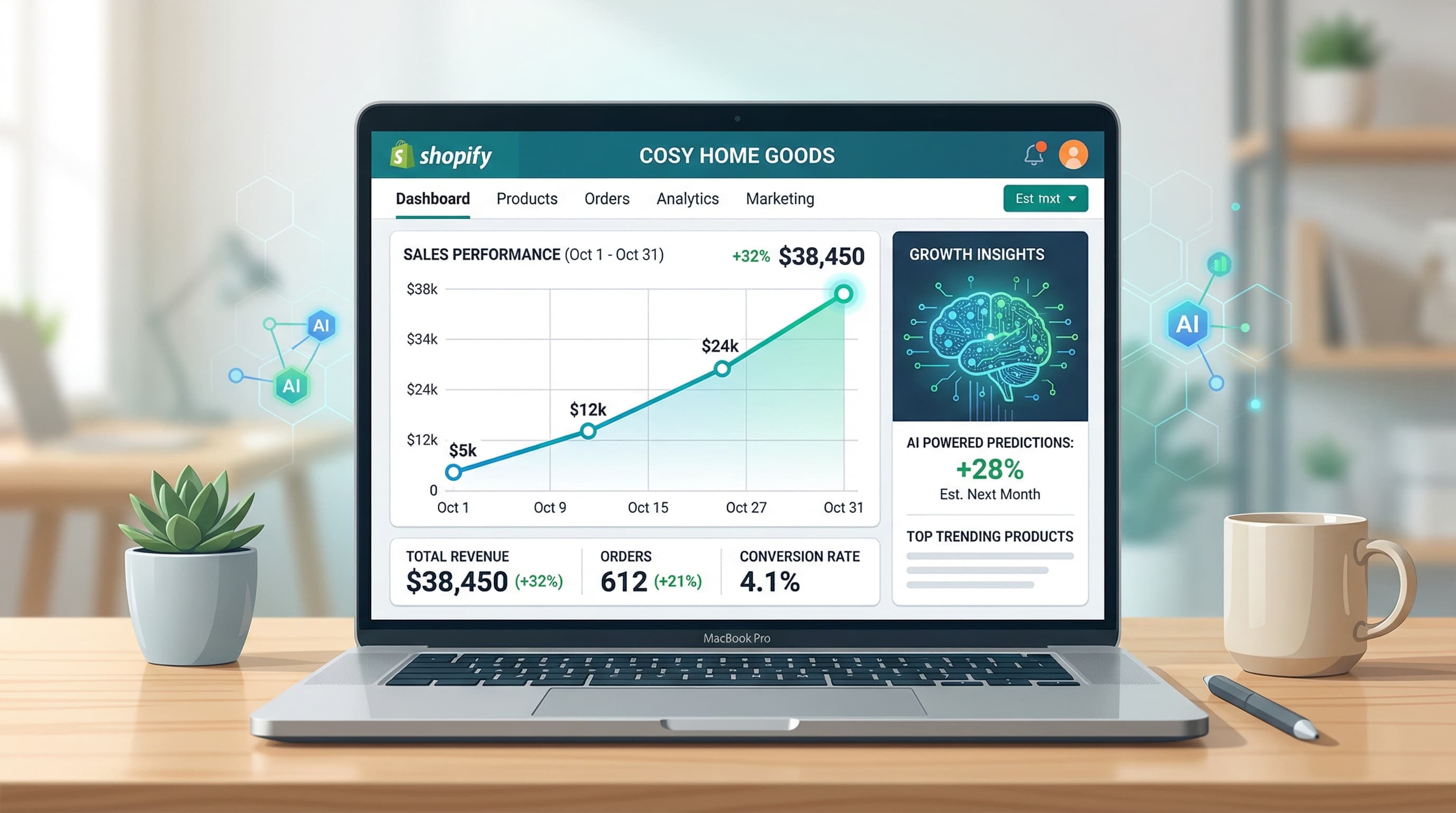
If you run a Shopify store in the United States, New Zealand or Australia, you are operating in one of the most competitive e-commerce search environments in the world.
Google processes over 8.5 billion searches every day. A growing percentage of those searches now return AI-generated answers, zero-click results, and personalised overviews that never send the user to a website at all. Meanwhile, Shopify powers over 10% of all e-commerce in the US alone — meaning the competition for the same keywords, the same customers, and the same sales has never been more intense.
The brands winning organic search in 2026 are not the ones spending the most on ads. They are the ones that have fundamentally rethought their approach to SEO — moving from a manual, reactive discipline to an intelligent, AI-driven strategy that scales with their store and adapts to how search actually works today.
This guide covers everything a Shopify store owner needs to know about AI-driven SEO in 2026 — from how the algorithm has changed, to practical implementation across product pages, content, technical SEO, link building, and analytics. Whether you are based in Sydney, Melbourne, New York, or Los Angeles, the principles in this guide apply directly to how your store ranks, converts, and grows.
"SEO is no longer a checklist. In 2026, it is a continuous intelligence operation — and AI is the analyst that never sleeps."
Table of Contents
- How AI Has Fundamentally Changed Search in 2026
- The State of Shopify SEO: What's Working and What's Dead
- AI-Powered Keyword Research for Shopify Stores
- Optimising Shopify Product Pages for AI-Driven Search
- Collection Pages: The Most Underutilised SEO Asset in Shopify
- AI Content Strategy for Shopify: Blogging, Guides, and Topical Authority
- Technical SEO for Shopify: The 2026 Audit Checklist
- Schema Markup and Structured Data for Shopify
- Link Building in the Age of AI: What Still Works
- Local SEO for Shopify Brands with Physical Presence in the US and Australia
- International SEO: Ranking in Both the US and Australian Markets
- Measuring SEO Performance: Metrics That Actually Matter
- The AI SEO Tech Stack for Shopify in 2026
- Key Takeaways and Action Plan
1. How AI Has Fundamentally Changed Search in 2026
Understanding the landscape is not optional. If your SEO strategy is built on assumptions from 2022 or 2023, you are optimising for a search engine that no longer exists.
Google's AI Overviews and What They Mean for Shopify
Google's AI Overviews — the AI-generated summaries that now appear at the top of a significant proportion of search results — have had a measurable impact on organic click-through rates. For informational queries, some studies report CTR reductions of 30–60% for the top organic results when an AI Overview is present.
For Shopify stores, this has two critical implications:
First, if your SEO strategy is built primarily on informational content (how-to guides, buying advice, educational posts), you need to rethink how that content is structured to either appear within AI Overviews or drive traffic through complementary channels.
Second, transactional and commercial queries — the ones that drive actual purchases — are less susceptible to AI Overview interruption. Searches like "buy [product] online Australia," "[brand] vs [brand] review," or "best [product category] for [use case]" still drive significant click-through to product and collection pages. These are the queries Shopify SEO should be ruthlessly focused on in 2026.
"The goal in 2026 is not just to rank. It is to appear within AI-generated answers for awareness queries and to dominate transactional results for purchase-intent queries."
The Rise of Semantic and Topical Search
Google's algorithms have moved decisively away from keyword-matching toward topical authority — a model where the algorithm assesses how comprehensively a website covers a given subject area, not just how many times it mentions a specific phrase.
For Shopify stores, this means isolated product pages targeting single keywords are no longer sufficient. Ranking consistently in 2026 requires building a web of interconnected content — product pages, collection pages, blog posts, FAQs, and guides — that collectively signal deep expertise in your category.
Zero-Click Search and How to Adapt
A growing proportion of Google searches now end without a click. Featured snippets, knowledge panels, AI Overviews, and People Also Ask boxes answer the query directly in the results page.
Shopify stores cannot afford to ignore this. The correct response is not to avoid these features — it is to own them . Appearing in a featured snippet or AI Overview for a relevant query is a significant brand awareness and trust signal, even when it does not generate an immediate click. The user remembers the brand. They return when they are ready to buy.
2. The State of Shopify SEO: What's Working and What's Dead
Before building a 2026 strategy, it is essential to be clear about what is no longer effective.
What Is Dead (or Dying)
Keyword stuffing in product titles and descriptions. Google's natural language processing is sophisticated enough to identify and penalise over-optimised copy. Product descriptions that read like keyword lists actively harm rankings and conversions.
Thin, duplicate, or manufacturer-copied product descriptions. Shopify stores running hundreds or thousands of products with manufacturer descriptions are carrying a significant SEO liability. Google treats duplicate content as low-value and deprioritises it in rankings.
Isolated blog posts with no topical connection. A blog post published once and never updated, with no internal links to product or collection pages, contributes almost nothing to a Shopify store's ranking authority in 2026.
Exact-match anchor text link building. Unnatural link profiles built on exact-match anchors (e.g., "buy cheap running shoes Australia") are a Penguin penalty risk and increasingly ineffective.
Ignoring Core Web Vitals. Page speed and user experience metrics are confirmed ranking factors. Slow Shopify themes are an SEO liability, not just a conversion problem.
What Is Working in 2026
- Deep, genuinely helpful content that addresses buyer questions comprehensively
- Topical authority built through interconnected content clusters
- Schema markup and structured data implementation at scale
- AI-assisted content production with strong human editorial oversight
- Technical SEO as a continuous monitoring discipline, not a periodic project
- E-E-A-T (Experience, Expertise, Authoritativeness, Trustworthiness) signals embedded throughout the site
- Strategic internal linking that distributes authority to commercial pages
- Video and image optimisation as search increasingly surfaces multimedia results
"The stores ranking at the top of Google in 2026 have not found shortcuts. They have built genuine authority — and used AI to do it faster than their competitors."
3. AI-Powered Keyword Research for Shopify Stores
Keyword research has always been the foundation of SEO. AI has not eliminated the need for it — it has made it dramatically more powerful.
From Keywords to Intent Clusters
The fundamental shift in AI-powered keyword research is from individual keywords to intent clusters — groups of semantically related queries that represent a coherent stage in the buyer journey.
For a Shopify store selling premium skincare products in the US and Australia, a traditional approach might target: "buy vitamin C serum," "vitamin C serum USA," "vitamin C face serum."
An intent cluster approach maps the entire conversation around that product category:
Awareness queries (informational intent):
- "What does vitamin C serum do for skin?"
- "How to use vitamin C serum in your skincare routine"
- "Vitamin C serum benefits for hyperpigmentation"
Consideration queries (commercial investigation):
- "Best vitamin C serum for sensitive skin Australia"
- "Vitamin C serum vs retinol — which is better?"
- "[Brand A] vs [Brand B] vitamin C serum review"
Transactional queries (purchase intent):
- "Buy vitamin C serum online Australia"
- "Vitamin C serum free shipping USA"
- "Best vitamin C serum under $50"
By mapping content, product pages, and collection pages to each cluster, a Shopify store builds both ranking breadth and conversion depth across the entire buyer journey.
AI Tools for Shopify Keyword Research in 2026
Semrush and Ahrefs remain the industry standard for keyword data, but their AI features have advanced significantly. Both now offer intent classification, topical clustering, and content gap analysis that can identify exactly where a Shopify store is losing ground to competitors.
Surfer SEO provides real-time content briefs based on what the top-ranking pages for any query include — a powerful tool for ensuring Shopify blog content and product descriptions cover the right topics.
Google Search Console remains free and irreplaceable. The queries report reveals exactly what searches are already driving impressions and clicks to a store — the starting point for any optimisation effort.
ChatGPT and Claude are now widely used for generating long-tail keyword variations, identifying question-based queries, and building out content briefs at scale. Used in combination with traditional keyword tools, they dramatically accelerate the research phase.
"AI keyword research doesn't replace human judgement — it eliminates the 80% of manual work that was slowing it down."
Long-Tail Keywords: The Highest-ROI Opportunity for Shopify in 2026
Long-tail keywords — specific, lower-volume queries — consistently deliver higher conversion rates than broad head terms. They are also significantly less competitive, meaning Shopify stores can rank faster and with fewer resources.
For US and Australian markets specifically, long-tail keyword opportunities include:
- Location-modified queries: "best [product] online Australia," "free shipping [product] USA"
- Use-case queries: "best [product] for [specific need or problem]"
- Comparison queries: "[product A] vs [product B] Australia 2026"
- Question queries aligned with FAQ schema implementation
4. Optimising Shopify Product Pages for AI-Driven Search
Product pages are the commercial engine of a Shopify store. They are also the most commonly under-optimised pages on the entire site.
Title Tags: The Most Impactful On-Page Element
A product page title tag in 2026 should accomplish three things simultaneously: include the primary keyword naturally, differentiate the product, and drive click-through from search results.
Weak title tag: Vitamin C Serum | My Shopify Store Strong title tag: Vitamin C Serum 20% – Brightening & Anti-Ageing | Free Shipping AU & US
AI tools can generate and test title tag variants at scale — a significant advantage for stores with large product catalogues.
Meta Descriptions: Conversion Copy for Search Results
Meta descriptions do not directly influence rankings, but they significantly influence click-through rate — which does. In 2026, meta descriptions should be written as conversion copy: specific, benefit-led, and action-oriented.
They should also include market-relevant signals for US and Australian audiences: free shipping thresholds, currency clarity, delivery timeframes, and trust signals like "Australian-owned" or "Trusted by 10,000+ US customers."
Product Descriptions That Rank and Convert
The dual purpose of a product description — SEO ranking and visitor conversion — is not a contradiction. The same qualities that make a product description compelling to a buyer (detailed, specific, benefit-focused, question-answering) also make it valuable to search engines.
AI-assisted product description workflow:
- Identify the top 3–5 questions customers ask about the product (from reviews, support emails, Q&A sections)
- Brief an AI tool to write a description that answers those questions while incorporating primary and semantic keywords
- Edit for brand voice, accuracy, and genuine value-add
- Add specifications, materials, dimensions, and use-case information
- Include a clear call-to-action
For large Shopify catalogues — hundreds or thousands of products — this workflow makes comprehensive optimisation achievable at a scale that would be impossible manually.
"Every product description is a ranking asset and a sales tool. In 2026, AI makes it possible to treat every single one with the same strategic attention."
Image SEO: The Underutilised Ranking Channel
Google Images drives significant e-commerce discovery traffic, particularly in the US and Australia for fashion, homewares, beauty, and lifestyle categories.
Shopify product image optimisation in 2026 includes:
- Descriptive, keyword-rich file names (not "IMG_4392.jpg" — "vitamin-c-serum-30ml-brightening-australia.jpg")
- Alt text that describes the image accurately and naturally includes relevant keywords
- Image compression for Core Web Vitals compliance without sacrificing quality
- WebP format implementation for faster load times
- Multiple product images covering different angles, use cases, and lifestyle contexts
5. Collection Pages: The Most Underutilised SEO Asset in Shopify
If product pages are the commercial engine, collection pages are the strategic highway that drives traffic to them. Yet in most Shopify stores, collection pages are treated as basic category listings — a wasted opportunity of significant proportions.
Why Collection Pages Matter for Rankings
Collection pages sit at the intersection of high commercial intent and broad keyword reach. A well-optimised collection page for "natural skincare Australia" can rank for dozens of related queries simultaneously — capturing buyers at multiple stages of their decision journey.
What a High-Performing Shopify Collection Page Looks Like in 2026
Above the fold:
- H1 heading that includes the primary keyword naturally
- A concise introductory paragraph (150–200 words) that describes the collection, addresses buyer intent, and incorporates semantic keyword variations
- Filter and sort functionality that improves UX and creates crawlable faceted navigation
Below the fold / supplementary content:
- An expanded buying guide section (400–600 words) covering what to look for, common questions, and product comparisons within the collection
- FAQ section with schema markup targeting People Also Ask opportunities
- Internal links to related collections and top-performing product pages
"A collection page with strong supplementary content isn't just a category page — it's a content hub that earns rankings for an entire topic cluster."
Managing Faceted Navigation Without Creating Duplicate Content
Shopify's filter and sort functionality creates URL variations that can generate thousands of near-duplicate pages — a serious technical SEO liability for larger stores. The solution in 2026 involves a combination of canonical tags, robots.txt rules, and strategic URL parameter management. AI-powered technical audit tools can identify and prioritise these issues automatically.
6. AI Content Strategy for Shopify: Blogging, Guides, and Topical Authority
Content marketing remains one of the highest-ROI channels for Shopify SEO — but only when it is strategically connected to commercial pages and built around genuine topical authority.
The Content Cluster Model for Shopify
The most effective content architecture for a Shopify store in 2026 is the content cluster model : a central pillar page covering a broad topic comprehensively, supported by cluster pages covering specific subtopics in depth, all internally linked to relevant product and collection pages.
Example for an Australian outdoor gear Shopify store:
Pillar page: "The Complete Guide to Hiking Gear in Australia (2026)" Cluster pages:
- "Best Hiking Boots for Australian Terrain"
- "How to Choose a Hiking Backpack: Australia Buyer's Guide"
- "Hiking in National Parks: What Gear Do You Actually Need?"
- "Layering for Australian Weather: A Practical Guide"
- "Trail Running vs Hiking Gear: What's the Difference?"
Each cluster page links back to the pillar, to other relevant cluster pages, and to specific product and collection pages. This architecture signals topical authority to Google and distributes link equity strategically across the site.
AI-Assisted Content Production: The Right Framework
Google's Helpful Content guidelines are explicit: content should be created for people first , with genuine expertise, and should offer value that cannot be found by simply aggregating other sources.
AI can significantly accelerate content production — but the quality threshold has risen, not fallen, in 2026. The stores ranking with AI-assisted content are the ones that use it intelligently.
The five-stage AI content workflow for Shopify:
Stage 1 — Strategic Brief Define the target audience, search intent, primary keyword, semantic keywords, questions to answer, and word count. This stage is human-led and cannot be outsourced to AI.
Stage 2 — Research Augmentation Use AI to identify what the top-ranking pages cover, what questions they miss, and where there is an opportunity to create genuinely superior content.
Stage 3 — AI Draft Generation Generate a structured first draft using the brief. The AI produces the skeleton; the human provides the substance.
Stage 4 — Expert Enrichment Add original data, real-world experience, product expertise, brand voice, and specific insights that only your business can provide. This is the E-E-A-T layer that Google's algorithm weights heavily.
Stage 5 — Optimisation and Internal Linking Use tools like Surfer SEO or Clearscope to align with semantic relevance signals. Add internal links to relevant product pages, collection pages, and related content. Implement FAQ schema where appropriate.
"The stores that are winning content SEO in 2026 use AI to move faster — not to cut corners. The quality bar has not dropped. It has risen."
Content Frequency and Consistency
A common mistake among Shopify store owners is publishing content in bursts and then going quiet. Google's algorithm rewards consistent publishing cadence — regular signals of an active, growing site.
For most Shopify stores targeting the US and Australian markets, a realistic and effective content schedule is:
- 2–4 new or significantly updated pieces per month
- Quarterly review and refresh of top-performing existing content
- Ongoing FAQ and structured data updates aligned with new product launches
7. Technical SEO for Shopify: The 2026 Audit Checklist
Technical SEO is the foundation that all other efforts sit on. Strong content and great product pages cannot compensate for a site that Google cannot crawl, index, or load efficiently.
Core Web Vitals: The Non-Negotiable Performance Baseline
Google's Core Web Vitals — Largest Contentful Paint (LCP), Cumulative Layout Shift (CLS), and Interaction to Next Paint (INP) — are confirmed ranking factors with specific performance thresholds.
2026 benchmarks:
- LCP (page load speed): under 2.5 seconds
- CLS (visual stability): under 0.1
- INP (interactivity): under 200 milliseconds
Many Shopify themes — particularly heavily customised or app-laden themes — fail these benchmarks, creating a measurable ranking disadvantage. AI-powered performance tools can identify the specific elements responsible for poor scores and prioritise fixes by impact.
Shopify-Specific Technical Issues to Address in 2026
Duplicate content from product variants Shopify generates separate URLs for product variants (colour, size, material). Without canonical tags pointing to the primary product URL, these create duplicate content issues that dilute ranking signals.
Pagination and collection filtering Filter and sort URLs, if not properly managed, can generate thousands of near-duplicate pages. Implement canonical tags, noindex where appropriate, and ensure pagination uses rel="next" and rel="prev" correctly.
The /collections/ and /products/ URL structure Shopify's default URL structure is not ideal for SEO, but it cannot be fully customised. Work within the structure by ensuring handles (the URL slugs) are keyword-rich and descriptive.
App bloat and JavaScript rendering Every Shopify app adds JavaScript to the site's load. Apps that add significant load time without proportionate commercial value should be audited and removed. Use Google's PageSpeed Insights and Lighthouse to identify specific app impacts.
Crawl budget management for large catalogues For stores with thousands of products, ensuring Google's crawl budget is directed toward the most valuable pages — not tag pages, vendor pages, or filtered navigation variants — is an important ranking lever.
XML sitemap health Shopify generates an XML sitemap automatically, but it should be audited regularly to ensure it includes all important pages, excludes low-value pages, and is properly submitted to Google Search Console.
"Technical SEO in 2026 is not a once-a-year project. It is an ongoing monitoring discipline. AI makes continuous auditing possible at a cost that was previously unthinkable."
Mobile-First Indexing: Non-Negotiable for US and Australian Markets
Google has operated on a mobile-first indexing model for several years, meaning it primarily uses the mobile version of a site for indexing and ranking. In the US and Australia, over 60% of e-commerce browsing now happens on mobile devices.
Every Shopify store must be fully optimised for mobile — not just responsive, but genuinely designed for the mobile experience first. This includes tap target sizes, font legibility, checkout flow optimisation, and mobile page speed.
8. Schema Markup and Structured Data for Shopify
Structured data is one of the highest-impact, lowest-competition SEO opportunities for Shopify stores in 2026. It is also one of the most consistently under-implemented.
Why Schema Markup Matters More Than Ever in 2026
Schema markup — code that tells Google explicitly what your content means — enables rich results in search: star ratings, price information, availability, FAQs, breadcrumbs, and more. These rich results significantly improve click-through rates and are a key input into AI Overview generation.
Essential Schema Types for Shopify Stores
Product Schema Every product page should implement Product schema including: name, description, SKU, brand, price, currency, availability, and aggregate rating. This enables rich results showing price and availability directly in search results — a significant CTR advantage.
Review and AggregateRating Schema Star ratings in search results are one of the most powerful CTR signals available to e-commerce brands. Shopify review apps (including Shopify's native reviews) can output schema-compliant review data, but this should be audited to ensure it is correctly implemented.
BreadcrumbList Schema Breadcrumb structured data helps Google understand the site's hierarchy and enables breadcrumb rich results in search — improving both rankings and CTR for collection and product pages.
FAQ Schema FAQ schema on product, collection, and blog pages creates accordion-style rich results in Google search — capturing additional SERP real estate and aligning with People Also Ask features.
Organization and LocalBusiness Schema For Shopify brands with physical presence in the US or Australia, Organization and LocalBusiness schema signal credibility and support local search visibility.
"Schema markup is the closest thing to talking directly to Google. In 2026, the stores using it comprehensively have a measurable advantage over those that are not."
9. Link Building in the Age of AI: What Still Works
Backlinks remain one of Google's most important ranking signals. But the link building landscape in 2026 is dramatically different from even three years ago.
What No Longer Works
- Private blog networks (PBNs): Google's link spam algorithms have become significantly more effective at identifying and discounting artificial link networks.
- Guest posting at scale for links: High-volume, low-quality guest posting is identified and discounted. Guest posts on genuinely relevant, authoritative publications still carry value.
- Directory submissions: Irrelevant directory links add no ranking value and can create a spammy link profile.
- Exact-match anchor text manipulation: Unnatural anchor text distributions are a ranking penalty risk.
What Works in 2026
Digital PR and brand mentions Creating genuinely newsworthy content — original research, data studies, trend reports, expert commentary — earns links from high-authority publications in the US and Australia naturally. AI tools can assist in identifying story angles and the right media contacts.
Product reviews and roundups For Shopify brands with strong products, outreach to relevant bloggers, YouTube creators, and media publications for product reviews remains one of the most effective link acquisition strategies — particularly in the US and Australian markets.
Supplier and partner links Links from suppliers, stockists, associations, and industry partners are highly relevant and relatively easy to acquire with a direct relationship.
Broken link building AI-assisted tools can identify broken links on relevant websites and facilitate outreach to replace them with links to equivalent Shopify content — a scalable, white-hat link acquisition strategy.
HARO and expert commentary Help a Reporter Out (HARO) and similar platforms connect journalists with expert sources. Responding to relevant queries builds high-authority editorial links at no cost other than time.
"The best link building strategy in 2026 is the same as the best PR strategy: create something genuinely worth linking to, and make it easy for the right people to find it."
10. Local SEO for Shopify Brands with Physical Presence in the US and Australia
For Shopify brands that operate physical retail locations alongside their online stores, local SEO represents a significant and often under-utilised traffic channel.
Google Business Profile Optimisation
A fully optimised Google Business Profile is the foundation of local SEO for any Shopify brand with physical locations. In 2026, this means:
- Complete and consistent NAP (Name, Address, Phone) information
- All relevant business categories selected
- Comprehensive product and service listings
- Regular posts and updates
- Active review management — responding to every review, positive or negative
- High-quality photos of the physical store, products, and team
Reviews are a direct local ranking factor. A proactive review acquisition strategy — asking satisfied customers to leave a Google review at the point of purchase — is one of the highest-ROI local SEO activities available.
Location-Specific Landing Pages
For Shopify brands operating across multiple cities or states in the US, or across multiple Australian states, location-specific landing pages can capture significant local search traffic.
These pages should be substantively different from one another — not just a template with the city name swapped. They should include locally relevant information, location-specific inventory or services, local testimonials, and embedded Google Maps.
"A Shopify brand with physical stores in Sydney, Melbourne, and Brisbane has three distinct local SEO opportunities that most competitors are not fully leveraging."
11. International SEO: Ranking in Both the US and Australian Markets Simultaneously
For Shopify brands targeting both the US and Australian markets — whether from a base in one country or as a genuinely international operation — international SEO introduces complexity that must be explicitly addressed.
Hreflang Implementation for US and Australian Audiences
Hreflang tags tell Google which version of a page is intended for which language and regional audience. For a Shopify store targeting both US and Australian markets with the same language but different regional contexts (currency, shipping, spelling conventions), hreflang implementation is essential to avoid keyword cannibalisation and ensure the right page ranks in each market.
Shopify's native hreflang support has improved but often requires third-party app assistance or custom implementation for multi-market stores.
Currency, Pricing, and Market-Specific Content
Australian consumers expect AUD pricing, Australian spelling conventions (organisation vs organization), references to local shipping partners and timeframes, and compliance with Australian Consumer Law. US consumers expect USD pricing, US shipping references, and content calibrated to their market norms.
Beyond simply changing prices, truly effective international Shopify SEO involves market-specific product descriptions, market-specific landing pages for key categories, and localised metadata.
Domain Structure Decisions
For Shopify brands with significant ambitions in both markets, the domain structure decision — single domain with subdirectories (/au/ and /us/), subdomains (au.brand.com), or separate country-code TLDs (brand.com.au and brand.com) — has meaningful SEO implications that should be evaluated against commercial and operational priorities.
"International SEO for Shopify is not just about translating content. It is about signalling to Google — and to customers — that you are genuinely present in each market."
12. Measuring SEO Performance: Metrics That Actually Matter in 2026
With the rise of zero-click search and AI Overviews, traditional SEO metrics are increasingly incomplete as performance indicators. Shopify brands need a measurement framework that reflects how search actually works in 2026.
Metrics to Track
Organic Revenue and Organic Revenue Contribution The ultimate measure of SEO performance is commercial impact. Track organic revenue, organic revenue as a percentage of total revenue, and organic revenue by landing page category (product pages, collection pages, blog content).
Organic Visibility and Share of Voice Tools like Semrush and Ahrefs provide share of voice metrics — what percentage of clicks for a defined set of target keywords is your store capturing. This is a more complete picture of competitive position than individual keyword rankings.
AI Overview Appearances Google Search Console is beginning to surface data on AI Overview appearances. Third-party tools are developing capabilities to track which queries trigger AI Overviews featuring your content — monitor and optimise for these.
Featured Snippet and Rich Result Ownership Track the proportion of target keywords for which your store owns a featured snippet, People Also Ask answer, or rich result. These are high-value SERP positions that should be actively pursued.
Core Web Vitals Field Data Monitor real-user Core Web Vitals data from Google Search Console — not just lab data. Field data reflects the actual experience of your visitors and is the data Google uses for ranking decisions.
Content Decay Rate Pages that ranked strongly 6–12 months ago but are now declining represent a priority for refresh and re-optimisation. AI tools can identify content decay trends before they become significant traffic losses.
"If your SEO report shows rankings and traffic but not revenue, you are measuring the wrong things. Ultimately, SEO exists to drive commercial outcomes."
13. The AI SEO Tech Stack for Shopify in 2026
The right tools make a significant difference to the speed, scale, and quality of Shopify SEO execution. Here is a recommended stack for stores seriously invested in AI-driven SEO.
Research and Keyword Intelligence
- Semrush — Comprehensive keyword research, competitive analysis, and content gap identification
- Ahrefs — Backlink analysis, keyword research, and content explorer
- Google Search Console — Free, essential, irreplaceable
Content Strategy and Optimisation
- Surfer SEO — Real-time content optimisation aligned to SERP data
- Clearscope — Semantic keyword coverage and content grading
- Frase — AI-assisted content brief generation and optimisation
Technical SEO
- Screaming Frog — Comprehensive site crawl and technical audit
- Sitebulb — Visual site architecture and crawl analysis
- Google PageSpeed Insights / Lighthouse — Core Web Vitals and performance audit
Schema and Structured Data
- Schema App (Shopify app) — Automated schema generation and management
- JSON-LD for SEO (Shopify app) — Schema implementation for Shopify stores
Rank Tracking and Reporting
- Semrush Position Tracking — Daily rank monitoring for US and Australian markets
- Google Looker Studio — Custom reporting dashboards integrating Search Console, Analytics, and Shopify data
Link Building and Outreach
- Hunter.io — Contact finding for digital PR outreach
- BuzzStream — Outreach management and relationship tracking
- HARO (Help a Reporter Out) — Journalist query monitoring for link acquisition
"Tools amplify strategy — they do not replace it. The best AI SEO stack in the world will not overcome a fundamentally flawed approach. But the right tools, applied to the right strategy, compound results significantly."
14. Key Takeaways and Action Plan
Eighteen sections of strategy are only valuable if they translate into action. Here is a prioritised action plan for Shopify store owners in the US and Australia ready to implement AI-driven SEO in 2026.
Immediate Priorities (Month 1)
- Audit Core Web Vitals using Google Search Console and PageSpeed Insights. Identify and fix LCP and CLS issues on top product and collection pages.
- Set up Google Search Console if not already active. Review the top queries report to identify your current ranking opportunities.
- Implement Product schema and AggregateRating schema on all product pages.
- Review and rewrite title tags and meta descriptions on your top 20 product and collection pages.
Short-Term Actions (Months 2–3)
- Conduct a full keyword research audit using an intent cluster framework. Map keywords to specific page types across the buyer journey.
- Identify your top 5 collection pages and add optimised introductory copy and FAQ sections with schema markup.
- Begin a content cluster strategy: identify one pillar topic and produce the central pillar page plus 3–5 supporting cluster pages.
- Implement hreflang tags if targeting both US and Australian markets from the same domain.
Medium-Term Investment (Months 4–6)
- Build out a quarterly content calendar based on intent cluster keyword mapping. Target 2–4 pieces of content per month.
- Launch a digital PR campaign targeting relevant US and Australian publications for link acquisition.
- Conduct a full technical SEO audit using Screaming Frog or Sitebulb. Prioritise and fix duplicate content, canonical tag, and crawl budget issues.
- Establish a monthly SEO reporting dashboard tracking organic revenue, share of voice, and Core Web Vitals.
Final Thought
The Shopify stores dominating search in the US and Australian markets in 2026 are not the ones with the biggest budgets or the most complex technology stacks. They are the ones that have built genuine topical authority, created content that genuinely helps their customers, and implemented technical foundations that allow Google to understand and reward that effort.
AI has not made SEO simpler. It has made high-quality SEO more achievable — for brands willing to invest the strategic attention it requires.
The opportunity is real. The competition is real. The brands that act with intent and consistency in 2026 will build ranking advantages that compound for years.
What is your biggest Shopify SEO challenge right now? Whether you are based in Sydney, Melbourne, Auckland, New York, or Los Angeles — drop your question in the comments and let's work through it together. 👇
📍 Christchurch, New Zealand | Shopify Web Design, SEO & Digital Strategy for Brands across NZ, Australia & the USA
Alliance IT Solutions
Related Articles

How to Know When Your Website Needs a Redesign
Your website is often the very first impression your business makes. If it's slow to load, difficult to navigate, or looks like it was built a decade ago, potential customers won't wait around to give you a second chance. Many businesses hold on to outdated websites far longer than they should — and quietly lose leads, credibility, and revenue every single day as a result.
Read More
Shopify vs WordPress vs Webflow: Which Platform Wins for AI-Powered Websites in 2026?
The platform you build on shapes everything — your SEO ceiling, your AI capabilities, your maintenance costs, and your ability to scale. Here is the most complete, honest comparison for businesses in the US, Australia, and New Zealand.
Read More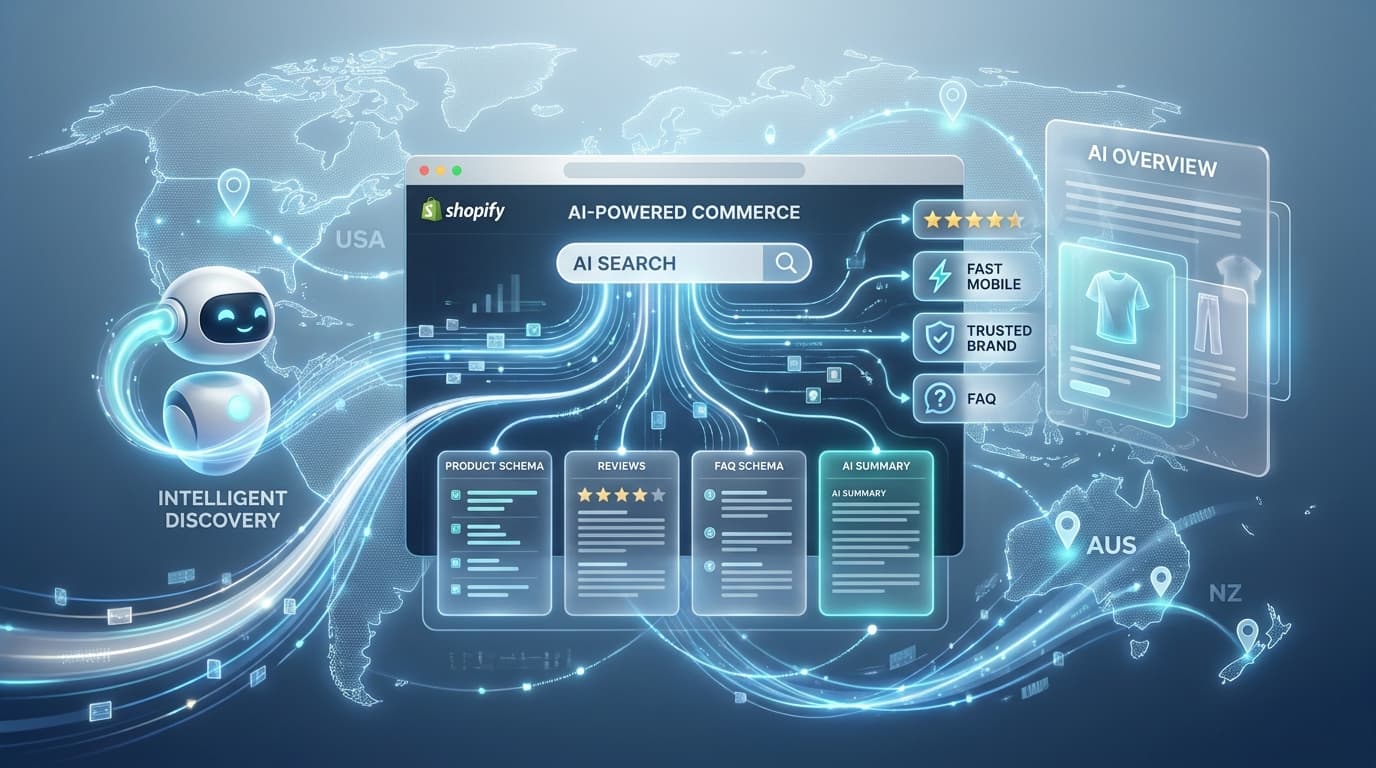
How AI-Powered Search Is Reshaping Shopify SEO in the US, Australia, and NZ
Google AI Overviews, ChatGPT, Perplexity, and Bing Copilot are changing how customers find products online. Here's what it means for your Shopify store — and exactly what to do about it.
Read MoreNeed Help with Your Project?
Our expert team is ready to help you implement these strategies and build amazing web solutions.
Get Free Consultation